
No items found.
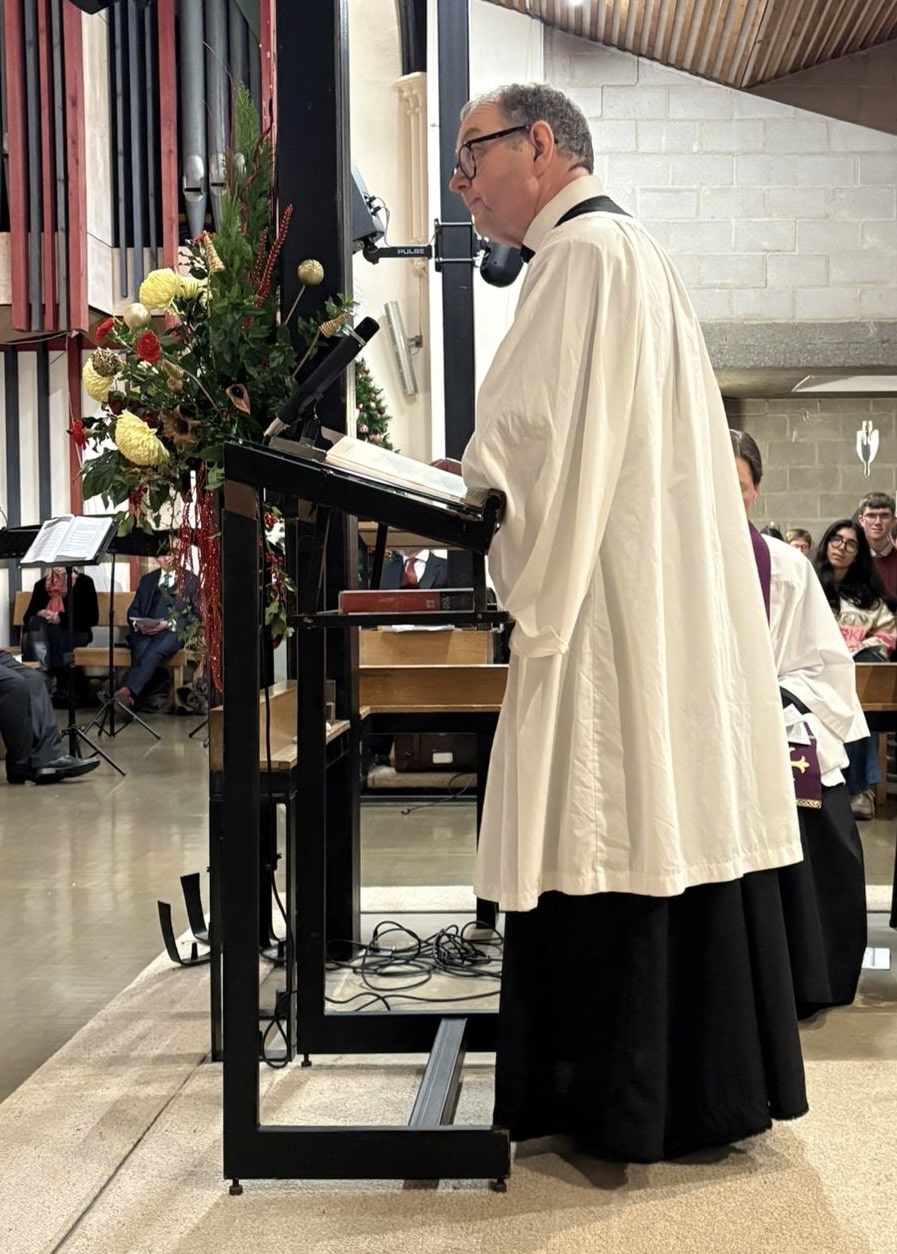
University Carol Service
December 2025
This evening, as candles glow and familiar carols rise in this place, we gather at the end of another term - perhaps exhausted, relieved, or quietly anxious about what still lies ahead. Christmas meets us exactly where we actually are, not where we wish we were. And the heart of this season is a story that refuses to stay in some distant past. It keeps happening - again and again - in our world, on our campus, and in the deepest places of our own lives.
Sometimes I surprise myself at the power of my prose style - the dramatic evocation of an atmosphere, the extraordinary gift of relating an ancient story to the present time, not only to our campus but even right down into the deepest recesses of our personal lives.
Except that I didn’t write a single wordof those overripe, and rather hackneyed, opening words. They appeared on my computer screen in answer to an appeal to ChatGPT. “Please compose a two thousand word sermon suitable for a carol service at the end of a university term.”
A recent study in University College London found that “Young adults are not only using AI to help them express themselves and understand those around them (but that) many are now using it to tell them what to do and think, as a neutral arbiter: less judgmental than their parents, more patient than their teachers, more reliable than friends. Always there, all-knowing and wise, a source of certainty in a chaotic world.” [Daily Telegraph 8/12/2025]
This cannot be anything other than a dangerous illusion. Artificial Intelligence is a useful tool, even a very useful tool, but it is still only a tool. We must not use it as an excuse to outsource our humanity.
I would like the students and staff of theUniversity of York to be able to describe their Chaplains in the same way that the author of the Letter to the Hebrews describes our Lord Jesus Christ: “Tempted every way that we are but without sin.” It is, of course, tempting to get Artificial Intelligence to write our assignments or our sermons for us. Tempting, but wrong. Wrong morally - but also flat, boring and lacking human interest.
I think you would be right to feel aggrieved and short-changed if you thought this whole sermon was written by an algorithm – not because you have a high expectation of what I might say; but because on an occasion like this you are right to expect something personal - personal both to the preacher and to the congregation; something unique, and not something that you might just as easily have done for yourselves.
It is not true, as we sometimes say when we are disappointed by a Christmas present, that “It’s the thought that counts”. What we actually mean is quite the opposite. It is the lack of thought that offends. But in fact, it is not really about “thought” at all, as if thought, ideas, what goes on in our heads, is the ultimate reality; that we can make something to be true simply by thinking it, or believing it, or by generating a disembodied thought using an algorithm. What we really want is thoughtfulness; for our thoughts to be embodied in human and entirely personal relationships.
This is true, of course, not only of sermons in church but in all kinds of different situations of human encounter in which good and bad, true or false, factual or inaccurate are not the only, or even the most important factors, but in which what matters above all is that what is communicated is personal and genuine.
More interesting than the string of truisms put together by AI is the way I phrased the question to ChatGPT. Why, exactly, did I feel obliged to write, “Please....”?
Partly, of course, because my mother told me often enough, at an impressionable age, always to say the magic word. But partly also, I think, because there is some deep desire, which I am not quite ready to abandon, for my appeal to be made not to some faceless, voiceless, soulless central processing unit but to another person; to one who knows me intimately and who understands my needs better that I understand them myself. Somebody whom I need to address with respect and some measure of awe, someone whom I would like to approach with gratitude and with some awareness of my dependence.There is something, perhaps, in the irrational urge to say “Please...” to a computer, of that fundamental human instinct to pray.
I know, of course, that it is completely ridiculous to say “Please” to ChatGPT; nevertheless, I feel strangely compelled to do it.
I do not believe that the instinct to say please, the instinct to pray, is in itself ridiculous. What is ridiculous is to address our petitions to something that is impersonal, something which, though it may give us answers in the short term, can give us no lasting satisfaction.
Dependence on artificial intelligence is only the most recent manifestation of what St Augustine observed 1,600 years ago - the human tendency to love creatures more than their creator; to look for satisfaction in what is passing rather than in what endures; to allow our tools to control us rather than to use the tools we are given to give glory to God and for the benefit of our neighbour:
“Let my soul use these things to praise you, O God, creator of them all, but let it not be glued fast to them by sensual love, for they are going whither they were always destined to go, toward extinction; and they rend my soul with death-dealing desires, for it too longs to be, and loves to rest in what it loves. But in them it finds no place to rest, because they do not stand firm; they are transient, and who can follow them with the senses of the body?” [Confessions 4.10.15]
This year, in the University Ecumenical Chaplaincy, and in our different parishes around the city, we have been celebrating the 1,700th anniversary of the Council of Nicaea. Especially important for tonight’s celebration of Christmas, we have been celebrating, above all, what that Council has to say about the nature and person of Jesus Christ. In words we affirm in our different churches Sunday by Sunday we celebrate that we believe in one Lord Jesus Christ, the Only Begotten Son of God, born of the Father before all ages. God from God, Light from Light, true God from true God, begotten, not made, consubstantial with the Father;through him all things were made.
Coming from different Christian traditions (Methodist, Anglican, Reformed and Catholic) we may disagree on how, precisely this is important; but we are in full agreement that it is important. Dogmatic definitions may lack the emotional impact of the Christmas story, of the Angels and theShepherds, the Ox and the Ass, the Wise Men and their exotic gifts, the birth of a child in poverty, cold and under the shadow of political violence; but dogmatic definitions such as the Nicene Creed are the cause and the condition of our unity.
We are a university community. Our task is to think, to understand, often to disagree but always with respect, to teach and to communicate. For theChaplaincy, our task is to do that especially for religion. What is the meaning of Christmas?
That is, of course, a vast question. One of the ways of answering it is to say thatthe Christmas Gospel, the Christmas “Good News”, tells us something about the kind of gift that Jesus Christ is to us. I would like to propose that not leastamong the gifts his birth gives to us is the possibility of the restoration of our humanity.
“SacredInfant, all divine, // What a tender love was Thine, // Thus to come from highest bliss // Down to such a world as this!” [See Amid the Winter’s Snow, Edward Caswall, Cong. Orat.]
The tender love of Our Lord Jesus Christ brings God down to us; brings God himself into our lives; brings God into a world full of people longing for a personal encounter with him; to men and women imbued with a deep instinct to pray but who inhabit a world so full of temptations, addictions, and distractions that such an encounter, such prayer, is almost impossible. Almost impossible, but not quite.
This, according to the Nicene Creed is the kind of gift that Jesus Christ is to us, that “for us men and for our salvation he came down from heaven, and by the Holy Spirit was incarnate of the Virgin Mary, and became man.”
God became man to overcome our fear of the dark, our fear that we are alone in a universe governed by blind forces and without love; God became man to destroy our illusion that we are the most important beings that exist and the that everything depends on us; God became man because he made, and knows, and trusts the humanity he made and knows that it can be, and will be, renewed, again and again.
It never seems to me to be particularly good news that God gives us commandments, even new commandments:to love one another, to love the Lord our God with all our mind soul and strength, to love our neighbour as our selves. Commandments are important, of course; butknowing ourselves as we do, we know that we are very often powerless to obey them.
It never seems to me to be particularly good news that Jesus Christ comes to us as an example of how we should live. His example is important, of course; but speaking for myself, I have been surrounded all my life by good examples, and spent a great deal of energy finding excuses to avoid having to follow them. There is still something in me of the obstinate child who resists that faintly threatening verse in the much-loved Victorian carol: “Christian children all must be mild, obedient, good as he”.
What is good news, what is a genuine, personal gift to humanity, is the message we get from St John’s Gospel. (This is, I believe, what is unique to our Christian religion.)
“He was in the world, and the world was made through him, yet the world knew him not. He came to his own home, and his own people received him not. But to all who received him, who believed in his name, he gave power to become children of God; who were born, not of blood nor of the will of the flesh nor of the will of man, but of God. And the Word became flesh and dwelt among us, full of grace and truth; we have beheld his glory, glory as of the only Son from the Father.”
Our salvation, our renewal, is dependent not on humanity alone, on the accidental ties of blood, of tribe or race or nation; or of the unpredictable and unruly passions of human flesh, or on the disordered and often violent aims of the naked human will; but on the power and the gift of God. When we understand that we begin to have a real understanding, and a hope for our humanity as something which has its origin and its end in God.
That in its turn, makes possible a real commitment to fulfil his commandments and to follow his example by entering into real, personal, embodied relationships with God, and with each other for his sake.
I began this sermon with an appeal to Artificial Intelligence. The answer came in bombastic but ultimately empty, meaningless words. Here are some better words from the Church, in this case from the Anglican Book of Common Prayer. They combine theological depth with restrained English prose. What is not to like in the Church of England’s Collect for Christmas Day? Inspired by God, it is addressed to him through Jesus Christ, who is the origin of our every prayer and the answer to them. It shows us the gift Christ is to us, tempted in every way that we are but without sin, with whom we can enter into a personal relationship, to whom we can pray, to whom we can, as if we were children, say “Please…”:
“Almighty God, who hast given us thy only-begotten Son to take our nature upon him, and as at this time to be born of a pure Virgin: Grant that we being regenerate, and made thy children by adoption and grace, may daily be renewed by thy Holy Spirit; through the same our Lord Jesus Christ, who liveth and reigneth with thee and the same Spirit, ever one God, world without end. Amen.”

