
No items found.
My dear Brothers,
I went last night with the Fathers to a play at the Fringe about Antoni Gaudí, the famous Catalan architect, who died one-hundred years ago this year, and who is best-known as the genius who designed the Sagrada Familia in Barcelona – although I discovered in the Surgeons’ Hall that in fact another architect was originally engaged. Nevertheless, this project embodies Gaudí’s vision. You may already know that he was on his way to the Barcelona Oratory when he was knocked over by a tram – he died from his wounds three days later, having been unrecognized, so scruffily was he dressed. He was in fact a Brother of the Little Oratory, and we can see the influence of St Philip in his life. I have said Mass at St Philip’s altar in our church in Barcelona, which has the face of Gaudí for the saint.
In the sixteenth-century, Philip reformed the Church not by invective, but by creating a new form of community life in which lightness and joy were a counter-fascination to the corruption and worldliness that marred the Church. Baronius describes the early Oratory as a re-creation of the primitive Church in her apostolic simplicity. In a similar way, Gaudí saw the flaws in the Church of his time – its association with landowners and political oppression – and sought to present an alternative vision of the a Church for the poor, very much in line with what Pope Leo XIII has written in Rerum Novarum. When other churches were desecrated in the anarchist riots of 1909, the Sagrada Familia remained untouched.
Gaudí was not alone in his Catholic social consciousness. Blessed Salvio Huix y Miralpeix, of the Oratory at Vic, and later Bishop of Ibiza, then of Lleida, began workers’ cooperatives, and a confraternity under the patronage of St Jospeh – just like the society that initiated the Sagrada Familia – to revitalize spiritual and parish life among working married men. The Barcelona Oratory had strong links with the Benedictines at Montserrat, and together they preserved a distinctively Catalan Catholicism at a time when the Catalan language and culture were forbidden.
In its time, the Barcelona Oratory was a highly impressive house. Its members were known as the ‘Secular Carthusians’ because of the strictness of their Oratorian observance, and when in the early twentieth-century certain Italian Oratorians wanted to centralize the Oratory, doing away with the autonomy of individual houses, it was the Fathers of Barcelona, together with the Oratories of Birmingham and London, who sent a ‘Solemn Protest’ to Rome, thus saving our institute from fatal change.
At the Sagrada Familia, Gaudí built a school on the grounds of the basilica for the children of the construction workers and local poor families. He was in some ways a Catholic equivalent of Ruskin or William Morris, in recognizing the dignity of manual labour – Gaudí’s father was a coppersmith – the workers at the Sagrada Familia were part of the endeavour, not merely employed by it, and Gaudí thought that it was important to create beauty in a poor area of Barcelona, because there is no reason why practical objects should not also be beautiful; in this he is a successor to the thought of Augustus Welby Pugin.
St Philip also understood the importance of beauty in bringing souls to God. He commissioned Barocci to paint the Visitation in the Chiesa Nuova – a picture before which Philip went into ecstasy.
Later, the Fathers employed Caravaggio to paint the Deposition from the Cross:
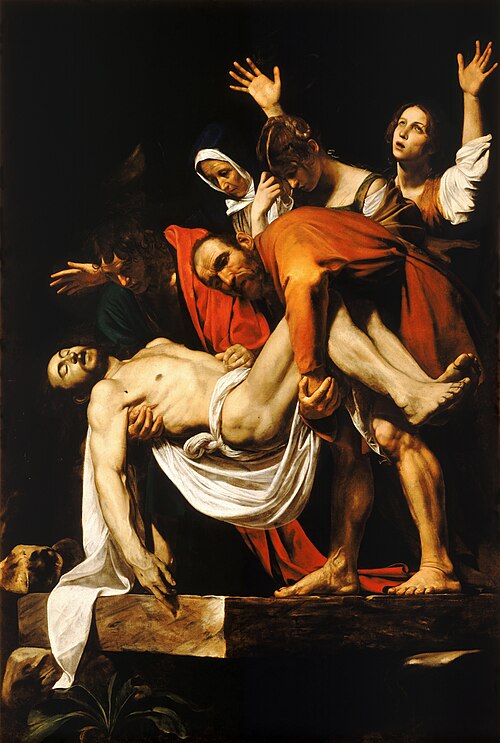
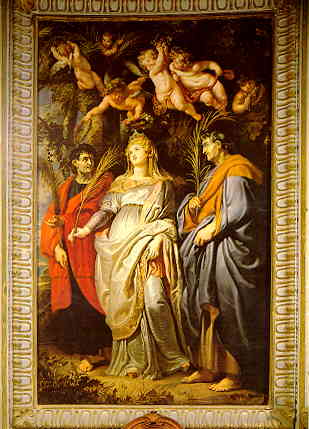
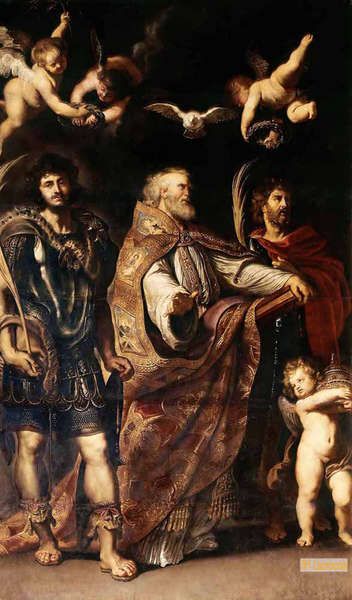
Unfortunately, that wicked man, Napoleon Bonaparte, stole our Deposition – it is now in the Vatican museums. The Corsican Ogre also wanted to take the paintings from around the High Altar, but fortunately, Sir Peter Paul Rubens had painted them on lead, and they couldn’t be removed. They are wonderfully Roman paintings, expressing as they do the nobility of those early martyrs Flavia Domitilla, Nereus and Achilleus, and of Pope St Gregory the Great (secondary patron of the Vallicella), along with SS Papias and Maurus, whose relics had been given to St Philip:
Most notably, the image of the Vallicella Madonna hides behind her Counter-Reformation makeover, so that the original can be revealed or hidden with a joyful playfulness that would surely have delighted St Philip. Now you can operate it with an electric zapper.
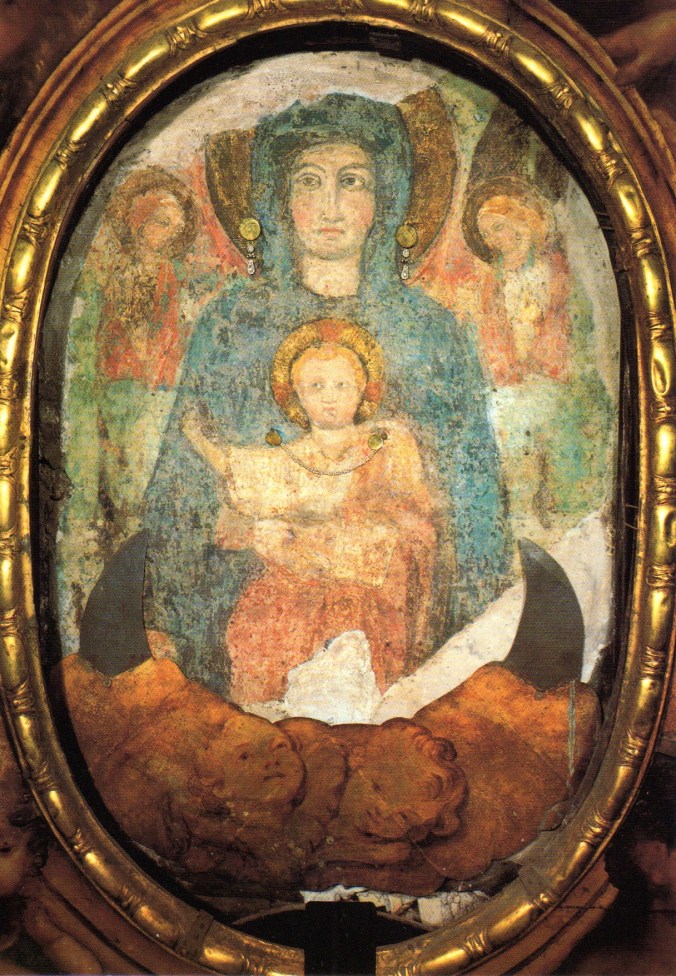
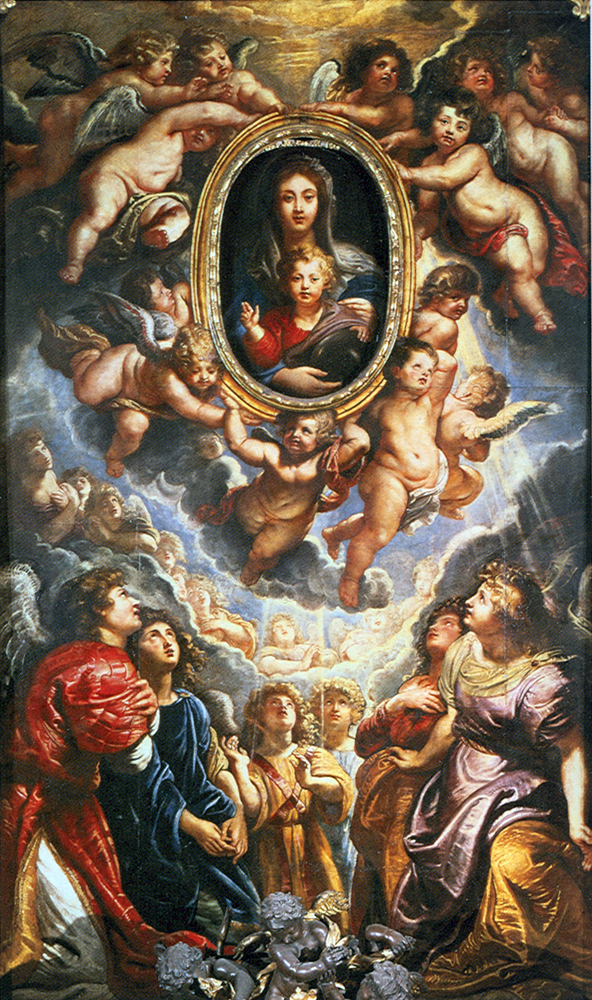
Such a device captures our Philippine capacity for dealing with serious matters lightly, for being able to innovate and surprise, above all for what the art critic Elizabeth Lev has described as the Oratorian charism for theatricality; surely an asset in this festival city.
For it was not a mere accident that Rubens was commissioned to paint these pictures. He was a convert from the gloom and heaviness of the Calvinist north, where, as Sandy says in Muriel Spark’s The Prime of Miss Jean Brodie, people would look at each other, “with predestination in (their) eyes.” If you believe in double-predestination, then you must be serious, because the Universe is running along railway tracks and there can be no subversion, no playfulness, no surprises. But it is a subversive, playful, surprising, God who becomes incarnate as a baby in Bethlehem. It was this God whom Rubens discovered when he was led into the Catholic Church, and why his paintings are suffused with colour, light, heat, and fragrance.
Rubens came from a place with a great history of art, but he turned his back upon its contemporary, ponderous, heaviness when he arrived in Rome in the Jubilee Year of 1600. Lev writes,
“One thing that certainly impressed upon Peter Paul Rubens during his Roman sojourn was the sense of theatricality that permeated the Eternal City. The processions and pageants, as well as the grand scenography of the liturgies, made saints and miracles come alive.”
Lev goes on,
“Rubens worked for the Congregation of the Oratory of Saint Philip Neri, which promoted sacred concerts and theatrical productions, and that sense of the stage emerged in Rubens’ work upon his return to (the Low Countries).”
In case we think that this visible, tangible, way of presenting the Gospel is merely a throwback to the Counter-Reformation, it is also something that has been rediscovered by the most compelling modern Catholic evangelists. Bishop Robert Barron, in To light a fire on the Earth, argues precisely the same point when he says that we should not begin, when seeking to bring others to Christ, with truth, or even with goodness, but rather with beauty. He says,
“There’s something more winsome and less threatening about the beautiful. “Just look,” the evangelist might say, “at Chartres Cathedral or the Sainte Chapelle, or at the Sistine Chapel ceiling, or the mosaics at Ravenna.” “Just read,” he might urge, “Dante’s Divine Comedy or Chesterton’s Orthodoxy. “Just watch” he might suggest, “Mother Teresa’s Missionaries of Charity at work among the poorest of the poor.”
None of this is to suggest that truth is not important. Indeed, no true beauty can be produced without truth. The cause of the malaise in modern art, architecture, and music, is that they have no truthful message to convey, no story to tell but meaninglessness. But what is undeniably off-putting to post-modern people is to start with what Bishop Barron calls ‘rule-talk’. He uses an analogy drawn from baseball, which I hope that none of you would understand, so I have translated it in the best tradition of inculturation. If you wanted to get someone to fall in love with the game of cricket, you wouldn’t star by explaining the complexities of the LBW rule, or how little light there has to be before the match is abandoned. You would start with the things that make cricket attractive: the tea, the smell of freshly-mown grass, the sound of willow against leather, and whatever else it is that makes people want to play sport. In the same way, says Barron, we should start evangelization with beauty. Capturing people with beauty is what Barron identifies with our Cardinal’s ‘illative sense’ the Grammar of Assent. Argument, said St John Henry Newman, is only a small part of why a person assents to something. “The illative sense imposes a variety of experiences, hunches, intuitions, and thoughts together.”
It is because of this that Bishop Robert Barron argues that Beauty is the first thing we should present, for strategic reasons. Truth is the ultimate thing, the most important thing, but it it is not what first captures people. For strategic reasons we must put first Beauty, then Goodness, then Truth. Because if we are serious about converting the world, starting with Scotland, then we must follow the best strategy to do so.
We Oratorians have another secret weapon, which is humour, playfulness, or lightness of touch. The Fathers of the Vienna Oratory once told me, “We Oratorians are too silly to be Herr Doktor.” Actual silliness is something people should find in us because it subverts expectation; it surprises, and shows that we refuse to take the world seriously. St Philip said that melancholy is a manifestation of sin, and in the same way we can always choose to be cheerful, to supress anger and gloom, and to sit lightly upon the troubles of life. The beauty of laughter, of child-likeness, of innocent humour, and of smiling countenances, these must be our contributions to the salvation of mankind. Miss Brodie was scornful of the Principal of the Marcia Blaine School for Girls, because Miss Mackay was an admirer of Stanley Baldwin, “who got in as Prime Minister and then got out again ere long.” Baldwin’s motto was , ‘Safety first’, but, said Miss Brodie, “Safety does not come first. Truth, and Goodness, and Beauty, these come first.” And the first of these we must show is beauty.

